
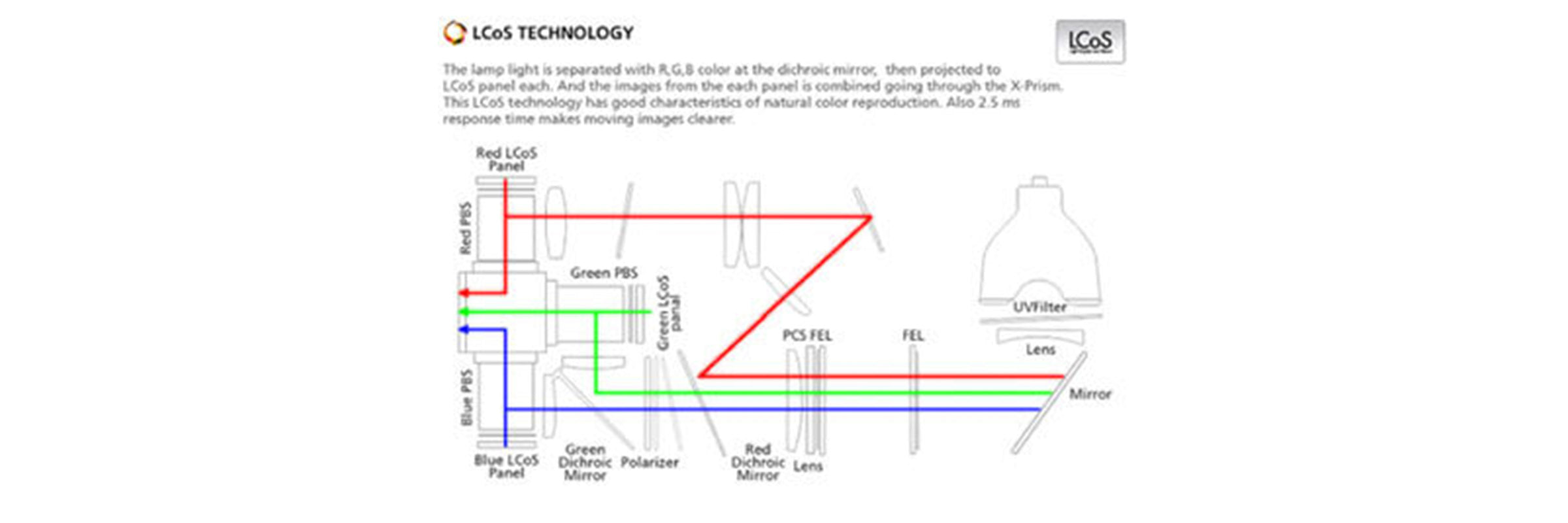
LCoS stands for "Liquid Crystal on Silicon" and is the name of a technology that uses special panels to create the image in projectors.
These work similarly to LCD technology but are reflective. This has the advantage that the conductor tracks for driving the pixels can sit behind the reflective layer. This achieves a higher "fill factor" and makes the pixel grid less visible.
LCD is a transmissive technology and DLP a reflective one. LCoS, in simple terms, is a combination of the two – an LCD panel on a mirror. The number of pixels is less restricted than with LCD or DLP technologies, because the electronics can be placed underneath the pixel rather than next to it.
This high pixel density automatically means high resolution. (In fact, most of today's LCoS projectors start at SXGA resolution.) The high pixel density also means no flicker, no "screen-door effect", no "rainbows" and an overall higher image quality with moving images. That's why many viewers say LCoS projects the clearest image.
LCoS technology has recently become even more important in current 3D projectors, as the fast switching of LCoS panels is an advantage here. Well-known LCoS variants are D-ILA (Direct (driven) Image Light Amplifier) from JVC and SXRD from SONY.

back to projector technology and terms
Matching product categories in the shop:
Further guides:
- Projector buying guide using the BEAM method – overview of all guides
- Projector A–Z – glossary of projection technology & projector terms – glossary of technical terms
- DLP, 3LCD or LCoS – DLP, 3LCD and LCoS compared head to head
