
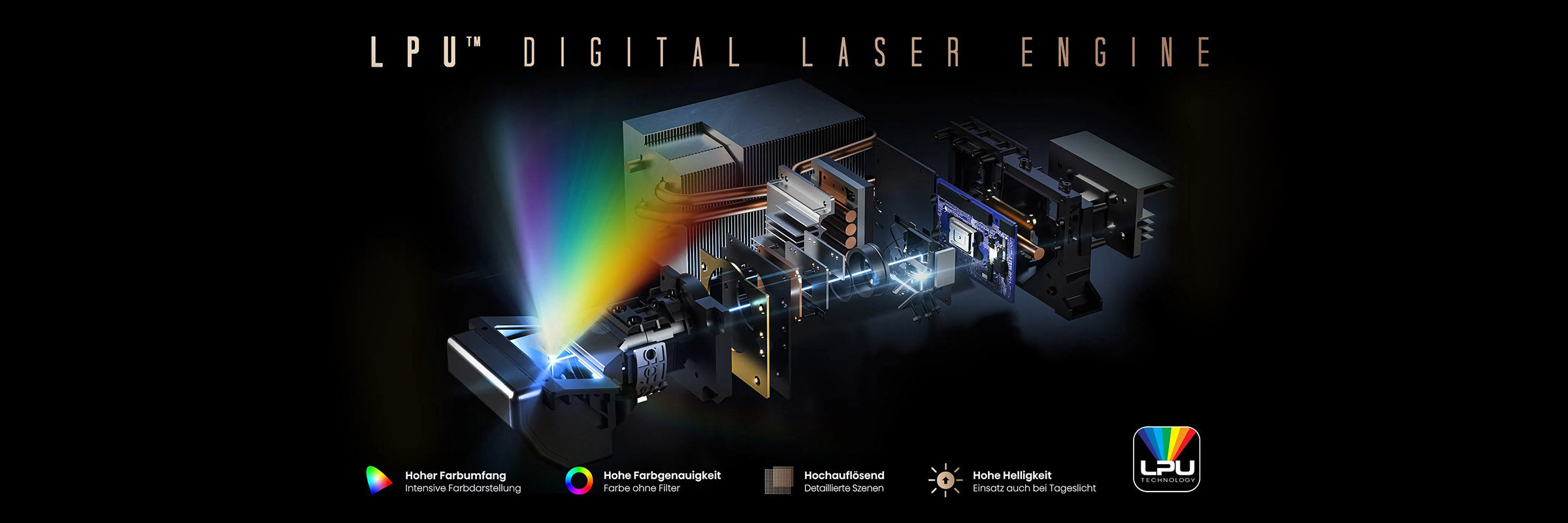
The key points in brief
Three methods create the image in a projector, and they differ above all where it matters for your buying decision: sharpness, colour brightness and black level – plus set-up and maintenance. DLP works reflectively with a micromirror chip, switches extremely fast and is often designed to need little maintenance. 3LCD works transmissively with three panels, uses the full light output for colours too and offers flexible placement. LCoS combines features of both principles and delivers the highest native contrast in premium home cinema.
Rule of thumb: a dark cinema room points to LCoS, a bright room with colourful content to 3LCD, gaming and continuous operation to DLP.
How does a projector work?
Every projector does the same thing in three steps: a light source produces white light, an imager forms the image from it, and a lens throws it onto the screen. The middle step is the actual projection technology – and that is where the devices differ.
Two things are often confused here. The light source (lamp, LED, laser or a hybrid) determines brightness, lifetime and start-up behaviour. The imager (DLP, 3LCD or LCoS) determines sharpness, contrast and colour behaviour. The two can be combined freely: there is laser DLP just as there is laser 3LCD.
This guide deals with the second of these. When the data sheet states which projection technology is used, the following tells you what that means for your picture.
How do the three methods differ technically?
All three modulate light, but in fundamentally different ways. It is precisely this architecture that determines what later appears in the data sheet: sharpness, contrast, colour behaviour, maintenance effort and flexibility of placement.
How does DLP work?
DLP stands for Digital Light Processing. It works reflectively. At its heart is a chip with up to 8.3 million tiny aluminium mirrors. Each mirror tilts between two positions in microseconds: "on" throws the light onto the screen, "off" directs it into an internal light trap.
The colours are created either sequentially via a rotating colour wheel or via three separate lasers that take turns in microseconds. Because a single chip handles all colours, convergence errors are impossible by design: the three colour channels simply cannot be offset from one another. Convergence offset is therefore ruled out – overall sharpness also depends on optics, focus and image processing.
How does 3LCD work?
3LCD is transmissive. The white light is split into its red, green and blue components by colour-selective mirrors (technically: dichroic mirrors) – these mirrors act like an optical switch that reflects certain wavelengths and lets others pass.
Each primary colour passes through its own liquid crystal panel, which controls the brightness per pixel. A prism recombines the three colour channels. Because the panels work in parallel, the full light output is also available for colours – by design, colour brightness (Color Light Output) reaches the level of white brightness. That is a real advantage as soon as there is light in the room.
By the way: when the shop or search queries refer to *LCD projectors*, this in practice means 3LCD devices – LCD is the technical umbrella term, 3LCD the three-panel implementation used in projectors.
How does LCoS work?
LCoS (Liquid Crystal on Silicon) combines features of both principles: it works reflectively but modulates the light via liquid crystals. A liquid crystal layer sits on a reflective silicon backplane, and the light passes through it twice.
The control electronics sit directly behind the mirror. This results in a pixel fill rate of over 90 per cent: the pixels sit so close together that no pixel grid is visible even from a short distance. The so-called screen-door effect that older devices showed at close viewing distances does not occur here. JVC markets its version as D-ILA, Sony as SXRD; technically, both are LCoS. You will find the details in our LCoS guide.
Is LED a fourth technology?
No. LED is a light source, not an imaging method. If you read "LED projector" in the data sheet, you are buying a device with LED light – the image is still created by a DLP, LCD or LCoS chip. Lamp, LED, laser and hybrid light sources are a separate dimension and independent of this question.
Head-to-head: DLP, 3LCD and LCoS
| Criterion | DLP | 3LCD | LCoS (D-ILA / SXRD) |
|---|---|---|---|
| Design principle | reflective, 1 chip | transmissive, 3 panels | reflective, 3 chips |
| Native 4K | no (pixel shift) | no (pixel shift) | yes with current home cinema chips (8.3 million pixels) |
| Native on/off contrast (without iris) | 600–5,000:1 | 5,000–20,000:1 | 15,000–150,000:1 |
| ANSI contrast | tends to be high | tends to be medium | medium to high |
| Colour brightness | can be below white brightness | on a par with white brightness | close to white brightness |
| Sharpness / convergence | no convergence offset | convergence adjustment needed | convergence adjustment needed |
| Pixel fill rate | 85–97 % | 60–80 % | over 90 % |
| Response time | microseconds | medium | medium |
| Placement / lens shift | often limited | large, flexible | large, flexible |
| Maintenance | tends to need less maintenance (sealed optics common) | depends on model, filter maintenance common | high-end usually sealed optics |
| Price range | entry level to upper class | entry level to upper class | premium segment |
*All figures are typical orders of magnitude for each design – not standardised and model-dependent. For a specific device, its own data sheet always applies.*
Summary: The design is not a quality ranking. Each method is a different technical compromise – what matters is which compromise suits your room and use. By design, DLP scores on convergence, switching speed and sealed optics, 3LCD on colour brightness and placement, LCoS on native contrast. How strongly this shows depends on the specific model.
Which of the three is right in the end depends mainly on two things: what the projector will be used for and how much it may cost.
Which technology for which use?
The quick overview first – the reasons follow below:
| Situation | likely to be of interest |
|---|---|
| Dark cinema room, maximum black level | LCoS |
| Bright room, colourful content | 3LCD |
| Gaming, compact placement | DLP |
| Text and presentations | DLP or 3LCD, depending on priority |
| Maximum placement flexibility | often 3LCD/LCoS (lens shift) |
| As little maintenance as possible, continuous operation | often laser DLP |
Which technology for a dedicated home cinema in a dark room?
LCoS, if the budget allows. If the room can be fully darkened, the walls are dark and the goal is maximum image quality for films, the high native contrast is the decisive difference. Add to that native 4K resolution and an invisible pixel structure.
Which technology for a bright living room?
Often 3LCD – but first: in bright rooms, room light, image size, actual lumens and the screen (gain/ALR) matter more than the design. The structural advantage of 3LCD is full colour brightness: with the same lumen figure, colourful content looks more vivid than with sequential colour generation. In addition, Epson's home cinema models offer generous lens shift, allowing placement without structural alterations. However, this does not apply to every device of this design and tends to be found in the higher price range.
On the other hand, bright DLP models such as the XGIMI TITAN have enough brightness to impress in a bright room too. Describe your room to us and we will work it out for both designs. You will find the selection under LCD projectors and DLP projectors.
Which technology for gaming and fast content?
Mostly DLP. The micromirrors switch in the microsecond range, which enables very low input lag – even in price ranges that are moderate by home cinema standards.
There is one argument in favour of 3LCD, though: by no means every device accepts 4K signals at 120 Hz, which is what current consoles and graphics cards output. The Epson EH-QB1000B can. Many devices that advertise 120 or 240 Hz mean Full HD – the combination of 4K and 120 Hz remains reserved for the upper class. If this matters to you, ask about it specifically.
Important: for maximum sharpness, position the projector physically correctly and avoid digital keystone correction – it increases input lag and costs sharpness. You will find suitable devices under Gaming projectors.
Which technology for conference rooms and training?
Both are strong here; the focus decides. For presentations with lots of text, diagrams and fine lines, DLP plays to its pixel-perfect sharpness and high ANSI contrast. For colourful slides, photo presentations and bright rooms, 3LCD plays to its colour brightness. For mobile use, DLP has the advantage thanks to its more compact design.
Which technology for continuous operation in signage, museums and control rooms?
Usually laser DLP: the combination of an inorganic micromirror chip, a laser light source and sealed optics needs particularly little maintenance. 3LCD devices are also capable of continuous operation, but with filter cooling they need maintenance intervals.
Two restrictions apply regardless of technology: 24/7 continuous operation applies to laser and LED light sources, rarely to lamp projectors, and the device as a whole needs explicit approval from the manufacturer. Tell us your preferred model and the planned running time – we will obtain approval from the manufacturer before you order.
Which technology for mini and travel projectors?
Predominantly DLP. The single-chip design dominates the compact segment because, with passive cooling, it fits best into small housings. One exception is the lifestyle devices of the Epson EF series: they bring the liquid crystal design, including full colour brightness, into a format that is still portable.
What does pixel shift mean, and what is native 4K?
When it comes to 4K, the three methods clearly part ways:
- DLP usually uses XPR pixel shift. A chip with a lower chip resolution is projected slightly offset two or four times per frame: the chip displays up to 8.3 million image positions in succession. The level of detail actually resolved lies between the native chip resolution and true 4K – in practice closer to 4K than the chip data would suggest.
- 3LCD uses a comparable shift principle under its own names, with two or four positions depending on the generation and implemented differently in technical terms.
- LCoS uses native 4K chips with physically 3,840 × 2,160 pixels in the current home cinema models from JVC and Sony. No shift method is needed there; older and smaller LCoS panels do not automatically reach this resolution.
Marketing likes to blur this distinction. We deliberately do not call pixel-shift devices "native 4K", even though the picture comes very close in practice. If you want maximum image quality for your money and are not building a dedicated cinema, pixel shift is usually the cheaper and still very good option. More on this in our 4K guide.
Common misconceptions
"High contrast automatically means a better picture"
Only half true. Marketing usually quotes dynamic contrast, measured with an electronic iris or laser dimming. For perceived image quality in normal scenes, it is largely meaningless.
Two other values count: native on/off contrast, measured without an adjusting iris, relevant in very dark scenes. And ANSI contrast, measured on a chequerboard pattern, relevant in normal scenes with mixed brightness. A device with lower on/off contrast can therefore look more three-dimensional than one with higher contrast. The measurement methods are explained in our guide to contrast ratio.
"LCD panels turn yellow over time"
That was true of older devices with organic polarising filters, which could develop a colour cast after several thousand operating hours. Current upper-class models use inorganic panels and polarisers and are much less sensitive to heat and UV. As a blanket statement, it no longer applies to this generation of devices.
"DLP always has colour fringes"
Largely outdated, but not entirely ruled out. With single-chip devices with a classic colour wheel, some viewers could perceive brief colour fringes during rapid eye movements. Colour wheels with six or more segments have reduced this considerably, and triple-laser models do without a colour wheel altogether – in their case, the cause is eliminated by design.
If you are particularly sensitive to it or know it from an older device, a model without a colour wheel or the liquid crystal design is the safe option. Let us know if you have experienced this – we will then narrow down the selection accordingly from the outset.
"An LED projector is a technology of its own"
No. LED describes the light source, not the imaging method. An LED projector still has a DLP, LCD or LCoS chip inside.
"LCoS is always best"
Only in the right context. In a living room with ambient light, a bright mid-range device can visibly beat a much more expensive but less bright LCoS model, because the ambient light lifts the black levels anyway. The technology should be chosen to suit the room, not the data sheet.
Frequently asked questions about the technology comparison
What is the most important difference between the three methods?
The way the image is created. DLP works reflectively with a micromirror chip, 3LCD transmissively with three panels, LCoS reflectively with liquid crystal on silicon.
Which projector technology is best?
None leads in every discipline. The question can only be answered once the room, lighting situation and use are clear – which is why this guide organises its recommendations by use rather than by technology.
What is 3-chip DLP, and do I need it?
Almost certainly not. With 3-chip DLP, three separate micromirror chips work together, one for each primary colour: no colour wheel, maximum colour accuracy, maximum brightness. This design is found in professional cinema and high-end installation devices, priced far above anything that would be considered for a living room or meeting room. In the device classes discussed here, the single-chip version is the rule.
What is the difference between LCoS, D-ILA and SXRD?
It is the same method. LCoS is the general term, D-ILA is JVC's brand version and SXRD is Sony's. Both are high-quality implementations: JVC traditionally achieves higher native contrast, while Sony builds more compactly.
Which imaging technologies are there in projectors?
Three are relevant for buying: DLP, 3LCD and LCoS. There are also special designs such as 3-chip DLP in professional cinema and laser phosphor variants, but these are variations of the same principles. Terms such as "LED projector" or "laser projector" do not describe a fourth technology but the light source.
Does technology or brightness play the bigger role?
In most living rooms, brightness, together with the right screen. The technology question only becomes decisive once enough light reaches the screen.
Advice and suitable projectors in the shop
More than 25 years of advising customers have shown us that choosing the technology is rarely the hard part. What is harder is matching the technology to the room – to the light level, the image size and what will actually be shown. A premium device with first-class black levels achieves little in a bright living room, because that is exactly where it cannot play to its strengths.
That is exactly what we take off your hands: describe your room, lighting situation and planned image size – our projector specialists will tell you which of the three designs has the better cards in your case and, if you wish, plan the complete system of projector, screen and mounting.
Go straight to the right areas of the shop:
- DLP projectors: sharp, fast, low-maintenance
- LCD projectors: full colour brightness, flexible placement
- Home cinema projectors: all three methods for every budget
- Gaming projectors: designed for low input lag
Further guides:
- Pixel shifting vs. native 4K in projectors – native 4K and pixel shifting compared
- Projector contrast ratio – what contrast figures really mean
- LCoS projectors – LCoS technology explained
