
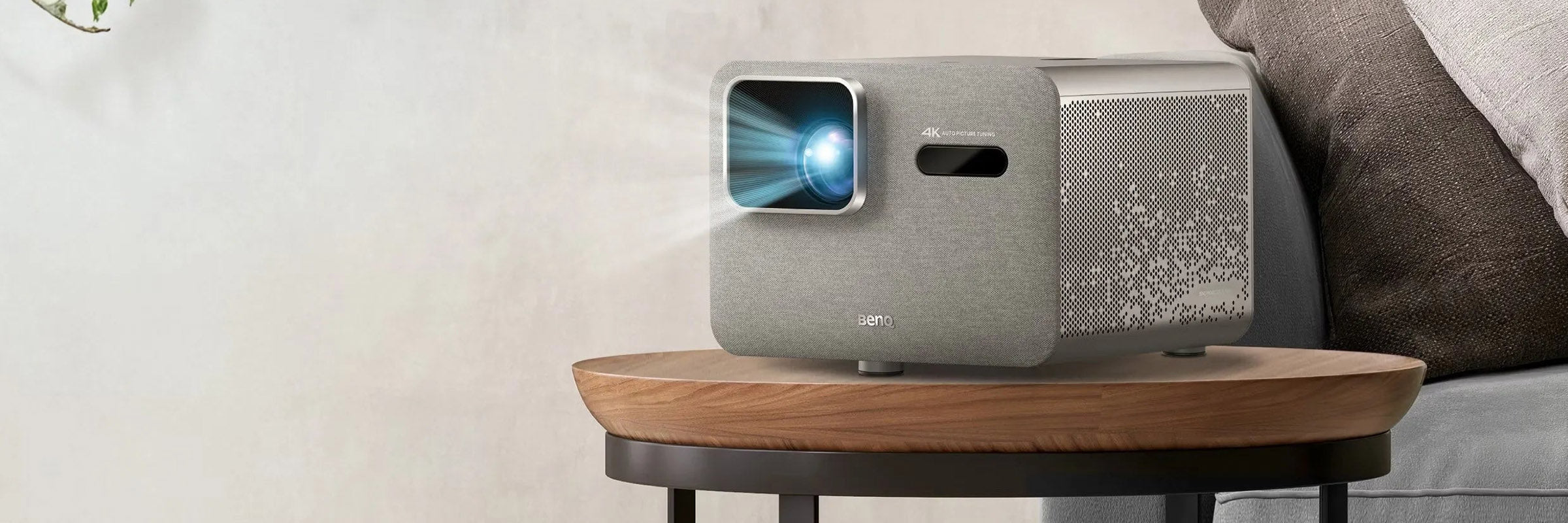
In brief: A TV scores in daylight and for everyday viewing: very bright, brilliant contrast, uncomplicated. A projector plays to its strengths with a large picture and cinema atmosphere – cheaper per square inch on large screen sizes, flexible in size and unobtrusive in the room. As a TV replacement in a bright living room, a laser TV (ultra short throw) or a projector with a contrast screen bridges the gap between the two worlds. Three questions decide – the 3W rule: wall size, windows and watching habits.
On this page
- The quick comparison
- Which is better: projector or TV?
- What the data sheet does not show
- The contrast screen
- Pros and cons at a glance
- Myths & half-truths
- Power consumption
- Sound and operating noise
- Can a projector replace a TV?
- Combining a projector and a TV
- Is a projector worth it?
- Frequently asked questions
Projector or TV: the quick comparison
On the data sheet, the TV often holds the better cards – more brightness, a stronger HDR effect, deeper blacks and less dependence on room light. But that does not settle the comparison, because a projector solves different problems: image size, integration into the living space, portability and cinema atmosphere.
| Criterion | TV | Projector | Laser TV (UST) |
|---|---|---|---|
| Image size | usually up to 85–100" | 100–150"+ flexible | 100–120" close to the wall |
| Brightness / daylight | very robust | needs light control | bright, suitable for living rooms with a CLR screen |
| Black level / HDR | usually stronger | depends on technology (SXRD/D-ILA strong) | good, depending on model |
| Cost per inch | rises sharply from 85" | low on large screen sizes | medium (incl. screen) |
| Effect on the room | permanently visible surface | screen can disappear | compact in front of the wall |
| Set-up | simple | needs more planning | medium (precise placement) |
We explain more about brightness in our guide to projector brightness; for image size and viewing distance, see our guide to screen distance.
Which is better: projector or TV?
The honest answer: it depends on the room and how you use it. Four questions reliably lead to a decision – the four-point check:
- 1 – Image size: Up to around 75 inches, a TV is straightforward. In the 85 to 100-inch zone, room, budget and logistics all play a part; from 100–120 inches, the projector plays to its size advantage.
- 2 – Integration into the room: Should the device be permanently visible or disappear when not in use?
- 3 – Lighting conditions: In strong, direct daylight, the TV has a clear advantage. A projector, on the other hand, copes well with ambient light – with the right contrast screen (ALR for a conventional projector, CLR for a laser TV; more on this in our guide Projectors in a bright living room). A room that can be darkened opens up the whole world of projectors anyway.
- 4 – Duration and type of use: Everyday medium (news, background viewing) or a deliberate film night?
When a TV is the better choice
A bright living room with a wall of windows that cannot be darkened during the day; frequent short viewing sessions, direct TV reception and maximum HDR peak brightness – here the TV is the more robust everyday device. However, its former "instant on" advantage is fading: modern laser and LED projectors are also ready to go in seconds.
When a projector is the better choice
A big picture from 100 inches, cinema atmosphere and the wish for a screen that disappears when not in use. The key factor is light control: a projector delivers its full, immersive big picture – the feeling of being right in the middle of the action – where the light can be controlled. That includes windows that can be darkened as well as indirect, dimmable lighting instead of full ceiling floodlighting. Viewing habits count too: if you mostly watch in the evening, you usually have the darkness you need anyway – for much of the year it is already dark at prime time. Especially for films, sports nights or gaming with several people, the larger image often feels far more immersive than a conventional TV.
What the data sheet does not show
Image quality can be measured – contrast, brightness, HDR. But much of what counts in everyday life is not on the data sheet:
| Factor | rather TV | rather projector |
|---|---|---|
| Contrast / HDR | objectively usually stronger | cinema-like big-screen effect |
| Daylight | much more robust | needs light control |
| Image size | expensive and heavy from 98–100" | easier at 100–150"+ |
| Living space | permanently visible surface | screen can disappear |
| Transport | difficult with large formats | projector and screen separate |
| Viewing feel | brilliant, direct, bright | reflected, perceived by many as calmer |
The most important practical factors in brief:
- A screen instead of a device: A large TV remains a visible dark surface even when switched off; a screen can be hidden discreetly – for example as a recessed ceiling screen.
- Big-screen logistics: From 98–100 inches, a TV becomes a question of delivery, stairwells and wall load. With a projector, the imaging device and the screen are separate.
- Viewing feel: Many people find a reflected image calmer than a self-illuminating panel during long film nights – a perception, not a measurement.
- No OLED burn-in, no local-dimming blooming: Static content such as channel logos or game scores does not burn in with projection as it can on self-illuminating panels, and there are no halos caused by local dimming as typical of Mini LED. On the other hand, a projector's contrast depends more on the room and the screen.
- A ritual rather than background viewing: A TV is the better everyday device; a projector is often the better device for the ritual of a deliberate film night.
- Modularity and control: With a projection setup, the imaging device and the streaming ecosystem can be kept separate. If you prefer Apple TV, Fire TV or another source device, you can replace it independently of the projector – instead of being tied to the built-in smart interface of one device.
- Freedom of format: With the right screen, true 21:9 cinema format and very large image widths are realistic.
The contrast screen: where the projector catches up
The TV's data sheet victories – brightness, ambient light, contrast – apply to the standard white screen. With an ALR contrast screen (ambient light rejecting, often called a "daylight screen" in shops), the picture changes: it absorbs ambient light instead of reflecting it and significantly boosts contrast and colour saturation in ambient light. In exactly the disciplines where the TV otherwise wins, the projector gains a lot of ground.
This screen is an item a TV does not need – not a surcharge without benefit, but the lever that unlocks the full performance. Factor it in, and the projector does not automatically become cheaper – but on large screen sizes it often becomes the more coherent overall solution in terms of image size, effect on the room and cost. To be honest: full, direct sunlight is TV territory, and a contrast screen needs to be fed enough lumens. Which fabric type suits your room is shown in the category Daylight & contrast screens.
Figuratively speaking, the screen is the racing car's tyres: even the most powerful engine cannot get its power onto the road if the tyres are wrong – only the right screen brings out everything the projector has to offer.
Pros and cons at a glance
What speaks for and against a projector – the advantages and disadvantages compared side by side:
| Projector advantages | Projector disadvantages |
|---|---|
| Huge picture (100–150"+), cheaper per square inch on large screen sizes | In daylight it needs light control or an ALR screen |
| Cinema atmosphere, immersive big picture | Installation needs planning (distance, screen, cable routing) |
| Image surface disappears when not in use (screen, ceiling lift) | Sound usually via soundbar/sound system, TV reception via a source device |
| Flexible and portable – pack it up and take it with you | Fan audible depending on model (laser/LED much quieter) |
| Modularity: free choice of source device, components replaceable individually | Black level and HDR peak usually below top TVs |
You will find details on imaging technology in our guide to 4K resolution in projectors.
Myths & half-truths
A few persistent sweeping judgements are worth setting straight – each with its grain of truth and the situation today:
| Myth | Grain of truth | Reality today |
|---|---|---|
| "Projectors only deliver a washed-out picture and need pitch darkness." | Older lamp and office projectors lost contrast in ambient light; sharpness and colours were secondary. | Modern 4K laser home cinema projectors deliver vivid colours and high sharpness – with an ALR contrast screen even in a bright living room. |
| "The lamp keeps breaking and is expensive." | Conventional UHP lamps are usually due after 3,000–5,000 hours, and a replacement often costs a three-figure sum. | Laser and LED light sources are typically rated for 20,000–30,000 hours (brightness decreases only slowly) – at a few hours a day, that means many years without changing a lamp (lamp or laser). |
| "Completely unsuitable for gaming." | Older projectors had noticeable input lag – not great for fast games. | Dedicated gaming projectors now achieve latencies close to TV levels; for sports, racing and couch gaming they have long been a serious option. |
| "A €200 mini projector is already a TV replacement." | Mini and pocket projectors are cheap and available everywhere. | Apples and oranges: charming second devices for the children's room – a full replacement only starts with a home cinema projector or laser TV projector. |
| "Projection is proven to be easier on the eyes." | Many people find a reflected big picture more pleasant and calmer. | That does not prove a medical advantage (blue light, sleep) – it remains a perception, not a measurement. |
Power consumption: projector vs. TV
There is no blanket winner when it comes to power consumption – what matters is image size, brightness, picture mode and viewing time. Large TVs and modern laser or LED projectors can be in similar power ranges, depending on how brightly they are run and what image area they cover. On very large screen sizes, projection can be efficient per unit of image area; eco mode throttles the projector even further. For a fair calculation, the source device, sound solution and viewing time belong in the equation alongside the device and screen – either way, the blanket "power guzzler" reputation no longer applies to current devices.
Sound and operating noise
Sound and operating noise also belong in the decision. In everyday use, a TV is usually simpler: speakers are built in and a soundbar is easy to connect. Many projectors do have their own speakers, but for film nights a soundbar or separate sound system is usually recommended; laser TVs are often closer to a TV here. As for operating noise: modern laser and LED devices run much more quietly than older lamp models and can be quietened further in eco mode – but a projector is never completely silent, which matters above all in small rooms or for seats close to the device.
Can a projector replace a TV?
Yes – in the right setup. For everyday viewing in a bright living room, a laser TV (ultra short throw) is the obvious solution: it sits close to the wall on the TV unit, delivers a large, bright picture and copes with ambient light thanks to a CLR contrast screen. TV reception and streaming run via a source device or the integrated operating system. A practical bonus: this way you often do not need to drill at all – the laser TV stands on the sideboard, and depending on the room, the matching screen is also available as a floor-standing version that needs no wall or ceiling mounting. Often all you need is the right piece of furniture. If you want more image area for less money, a conventional home cinema projector is the way to go – in a darkened room, or with an ALR screen even in ambient light.
Important: a laser TV does not replace a TV one-to-one. For good results it needs a matching CLR contrast screen, precise alignment and, despite its high brightness, usually more light control than a conventional TV – in return, it offers far more image area with a set-up that suits a living room.
How well the switch works in everyday life depends on the room: Light in the room, Alterations needed, Media use and Projection distance – the LAMP rule – tip the balance. A detailed decision guide will follow in a separate guide, "Projector as a TV replacement"; for an overview of devices suitable for living rooms, see the category Laser TV.
Combining a projector and a TV
Often the best answer is not "or" but "and": the news on the TV in the morning, film night on the big screen in the evening. A motorised or recessed ceiling screen is particularly elegant: it disappears almost invisibly into the ceiling when not in use and only comes down for film night, while the TV remains the everyday device. In front of a wall of windows it can also reduce stray light – but it is no substitute for a proper blackout system. In more elaborate home cinema setups, even the projector itself does not need to stay visible: with a ceiling lift, it retracts invisibly into the ceiling when not in use. This way you combine the everyday device with the ritual device without committing the room to one purpose. You will find suitable screen fabrics and mounting solutions in the category Projection screens.
Is a projector worth it?
For a very large picture, a projector is often worth it – especially if the room can be darkened and a suitable screen is planned in. Even entry-level projectors project a much larger image than a TV at the same price, and at 100 inches and above, projection is usually the cheaper way to get the image area. Alongside the device, the calculation should include the matching screen and possibly a mount – in return, you avoid the surcharge that every extra inch costs with a TV.
In short: the TV often wins on pure picture performance in a bright room. The projector wins where image size, effect on the room and integration into the living space matter more. We are happy to clarify which option suits your room in person – by phone or by email.
Frequently asked questions (FAQ)
Can you watch normal TV with a projector?
Yes. Via a satellite/cable receiver, a media/streaming player or the integrated operating system, TV and streaming content runs as usual – and with a laser TV it is particularly suited to everyday use.
Is a projector a good TV replacement in a bright living room?
Yes, with the right contrast screen: a laser TV (CLR screen, no installation) or a conventional projector with an ALR screen copes well with ambient light. In strong, direct sunlight, the TV remains superior.
Does a projector use more power than a TV?
Not necessarily. Consumption depends heavily on image size, brightness and picture mode; large TVs and modern laser/LED projectors are often in similar ranges. On very large screen sizes, projection can be efficient per unit of image area, and eco mode reduces power further.
How big does the room need to be for a projector?
That depends on the throw distance and image width. Ultra short throw devices need hardly any distance. The projection calculator on each product page shows the exact distance for a specific model; the basics are explained in our guide to screen distance.
Is a projector worth it instead of a TV?
For a large cinema format and a room where you can control the light: yes. For bright everyday use with frequent short sessions, the TV – or a laser TV – remains the more convenient choice.
Which is better for gaming: projector or TV?
For fast, competitive gaming, the TV usually has the edge – thanks to 4K/120 Hz, VRR and very low input lag. A gaming projector is worth it if the large image matters more than the last millisecond of response time – for example for sports and racing games or couch co-op. You will find suitable devices in the category Gaming projectors.
Do you absolutely need a screen for a projector?
A smooth, evenly white wall works as a stopgap, but costs contrast and sharpness. For a clean big picture – and in a bright room, an ALR contrast screen (a CLR screen for a laser TV) – a proper projection screen is the better solution in most permanent setups.
Would you like advice?
Our home cinema experts will work with you to find the solution that suits your image size, lighting conditions and budget – call us on 0221 – 719981 – 0, write to vertrieb@beamer-discount.de or use our contact form.
Matching product categories in the shop:
Further guides:
- Projector to screen distance – table and formula for the distance
- Pixel shifting vs. native 4K in projectors – native 4K and pixel shifting compared
- 4K projectors for bright living rooms 2026 – models for rooms with ambient light
