
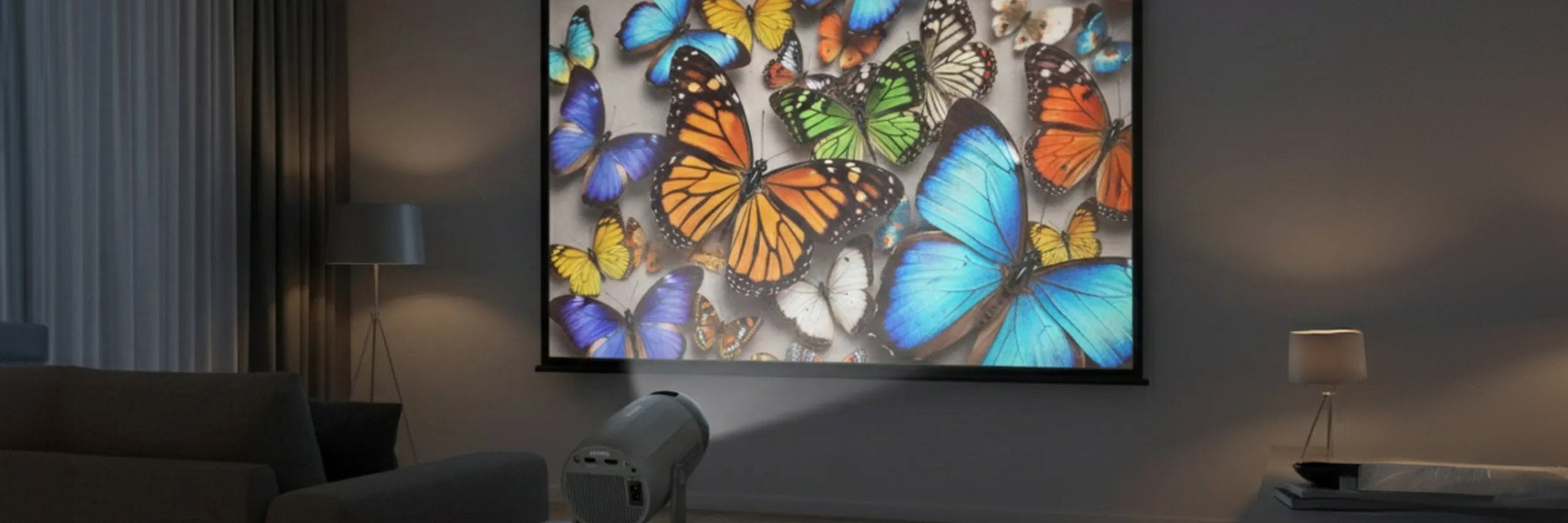
Put simply, the viewing angle indicates how centrally you're sitting in front of a screen. More precisely, it is the angle between your line of sight and a perpendicular to the projection surface. It increases the further you move to the side while still looking at the centre of the image.
As the viewing angle increases, projection quality generally decreases. How much depends on the screen, but unlike with a monitor it isn't a clear-cut quality criterion. Screens have different characteristics: they can reflect the light emitted by the projector in a mainly directed way (specular) or scatter it more widely.
Screens with a more diffuse reflection still offer a high-quality image at wider viewing angles, while more reflective screens concentrate the projector's light within a narrower angle, so they deliver a brighter image there. With rear projection, where a projector illuminates the screen from behind, the usable viewing angles are also rather small.
